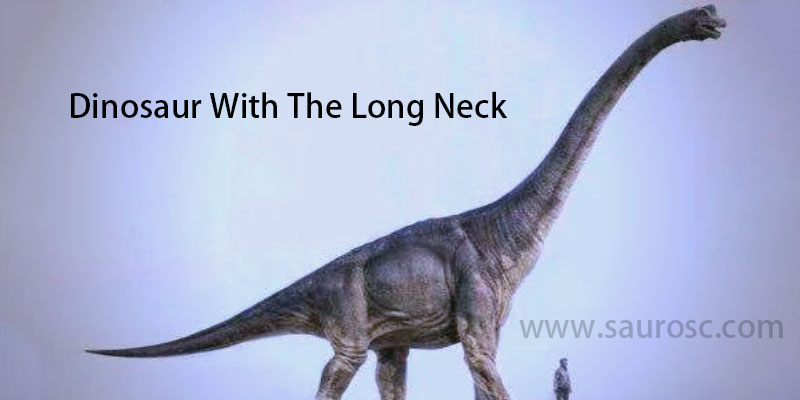
Dinosaurs, these colossal creatures that once dominated Earth’s history, encompassed a vast array of species, with the sauropods being particularly remarkable. Gigantosaurus, Diplodocus, and Titanosaurus were all formidable in size, many reaching lengths of tens of metres and weighing over a hundred tonnes. Yet which dinosaur possessed the longest neck?
Among sauropods, Giraffesaurus, Diplodocus, and Titanosaurus are all renowned for their immense size and elongated necks, each capable of reaching lengths between 30 and 60 metres – a truly awe-inspiring feat.
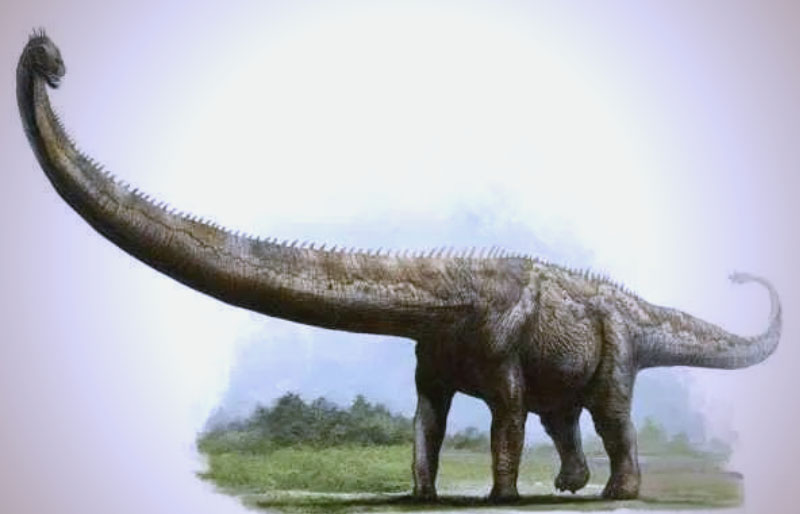
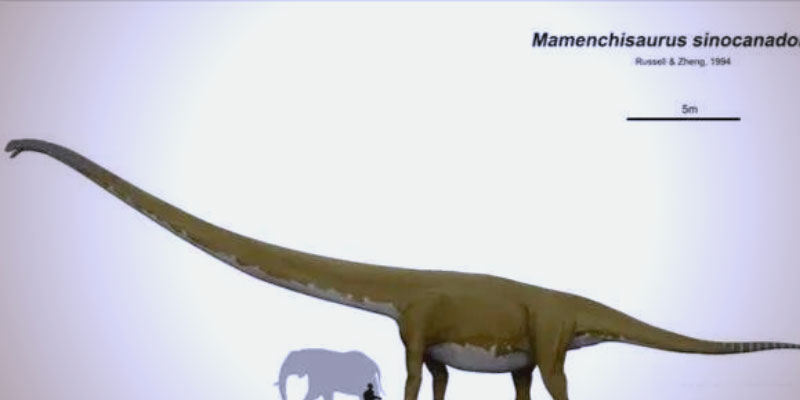
Mamenchisaurus, a sauropod dinosaur discovered at the Mamingshi Ferry in Yibin City, Sichuan Province, is celebrated for its astonishing size and neck spanning 30 metres. Its neck length accounted for over half its total body length, featuring not only exceptionally long cervical vertebrae but also an unprecedented 19 cervical vertebrae among sauropods. Moreover, Mamenchisaurus was one of the flourishing dinosaurs across China during the Late Jurassic period. Its fossils were first discovered in 1987; though only an incomplete skeleton was found at the time, it was already sufficiently astonishing. More excitingly, in 2021, scientists uncovered the most biodiverse Late Jurassic Mamenchisaurus faunal assemblage yet found in China at a concentrated burial site in Guangyuan, Sichuan. This discovery will undoubtedly further advance our understanding of this ancient creature.
Mamenchisaurus, the sauropod dinosaur unearthed at the Mamingxi Ferry in Yibin City, Sichuan Province, is renowned for its uniquely elongated neck. Yet despite its remarkable length, it does not hold the record for the longest neck among all dinosaurs. In China’s Xinjiang region, a dinosaur named Xinjiangosaurus shanshanensis has been discovered, possessing an even more colossal frame with a neck length surpassing that of Mamenchisaurus. This discovery undoubtedly adds new dimensions to the field of dinosaur research.
In 2012, a joint scientific expedition comprising institutions including Jilin University, Shenyang Normal University, and the Xinjiang Geological Survey discovered a fossilised sauropod dinosaur from the Middle Jurassic period in the area south of Qiketai, Shanshan, Xinjiang. Following analysis, this dinosaur was named Shanshanosaurus. Based on the excavated skeletal remains, scientists estimate this specimen could have reached a total length of 30 metres. Notably, the fossil preserves 18 cervical vertebrae, whose combined length exceeds 15 metres, accounting for over half the animal’s total body length. The twelfth cervical vertebra alone measures an astonishing 1.23 metres. Consequently, the combined length of the head and neck surpassed 16 metres – a length nearly equivalent to the height of three giraffes.
Some have suggested that the Xinjiang Dragon from Shanshan may possess the longest neck of any dinosaur globally. Given the fossil evidence unearthed thus far, this claim is not entirely unfounded. However, it is worth noting that Argentinosaurus and Diplodocus fragilis were significantly larger in stature. For instance, Argentinosaurus could reach lengths of 30 to 43 metres and weigh between 80 and 100 tonnes, making its neck length highly likely to surpass that of the Xinjiang Dragon.
Brachiosaurus is even more astonishing in size, with lengths of 40 to 58 metres and weights exceeding 150 tonnes, recognised as the largest dinosaur known to date. Nevertheless, due to the limited number of fossil discoveries for both species, precise data regarding their total length, weight, and neck length remain subject to further research. Consequently, while Diplodocus may have surpassed the Shanshan Giant in overall size, the exact length of its neck remains inconclusive.
Why did these dinosaurs evolve such elongated necks? Scientists hypothesise this may represent a unique feeding strategy developed through evolutionary adaptation. Their extended necks enabled them to efficiently graze on abundant local food sources without requiring extensive movement. Simultaneously, the long neck was likely perceived as a symbol of strength and vitality, aiding in attracting mates. However, this adaptation presented significant challenges, including mechanical constraints: sustaining such a neck demanded robust muscular support and stability. Moreover, efficiently transporting air to the lungs and expelling it posed a significant problem for long-necked dinosaurs. Scientists hypothesise that during evolution, these dinosaurs may have had to make certain compromises to adapt to their environment while maintaining the advantages of their long necks. For instance, they might have reduced their mobility to stabilise the neck, or limited skeletal flexibility to enhance the neck’s aerodynamics.
In August 2022, China achieved significant progress in dinosaur skeletal fossil research, formally naming 322 new dinosaur species. This brings China’s total number of identified dinosaur species to the highest globally, highlighting the nation’s substantial capabilities in palaeontology. To date, dinosaur fossils have been discovered across 22 provincial-level administrative regions nationwide. Liaoning leads with 63 species identified, followed by Inner Mongolia and Sichuan with 40 and 33 species respectively. Additionally, Xinjiang, Yunnan, Gansu, Henan, and Shandong represent significant areas for dinosaur skeletal fossil discoveries.
saurosc

Name:Peter Chan
Career:12 Years Amusement Park Designer
Experience
Related Posts
3D Printing Large Animal Models:Realistic,Creativity
Which Dinosaur Is The Dinosaur With The Long Neck?

Plastic Steel Cartoon Models And Animation Sculpture

How To Make An Anime 3d Model?

A Costume Enables You To Be A Real Dinosaur

Simulated Dinosaurs In The Park:A Realistic Dinosaur Experience

Realistic Dinosaurs Model:The Technology And Art

Lifelike Dinosaur Costume Youth:Super Cool Monster

Brontosaurus Dinosaur:The Power And Uniqueness

Allosaurus: The Most Graceful of Carnivorous Dinosaurs

What Is The Dinosaur Hand Puppets?

What Materials Was Used To Make The Simulation Dinosaur Models in Jurassic Park?
Product Categories